


 Back
From Automotive Sensing to Embodied AI: Four Application Scenarios of Maxic Magnetic Sensors
-

Release Date2026-11-02
-

Page View47 times

Physical AI is rapidly accelerating toward real-world deployment. Whether in joint control of humanoid robots or vehicle status feedback in autonomous driving, the core lies in establishing a closed loop of "perception, decision-making, and action." Magnetism, although invisible and intangible, is the physical foundation for machines to "sense" the real world. Magnetic sensors convert magnetic changes into electrical signals, providing devices with key data such as position, speed, angle, and current.
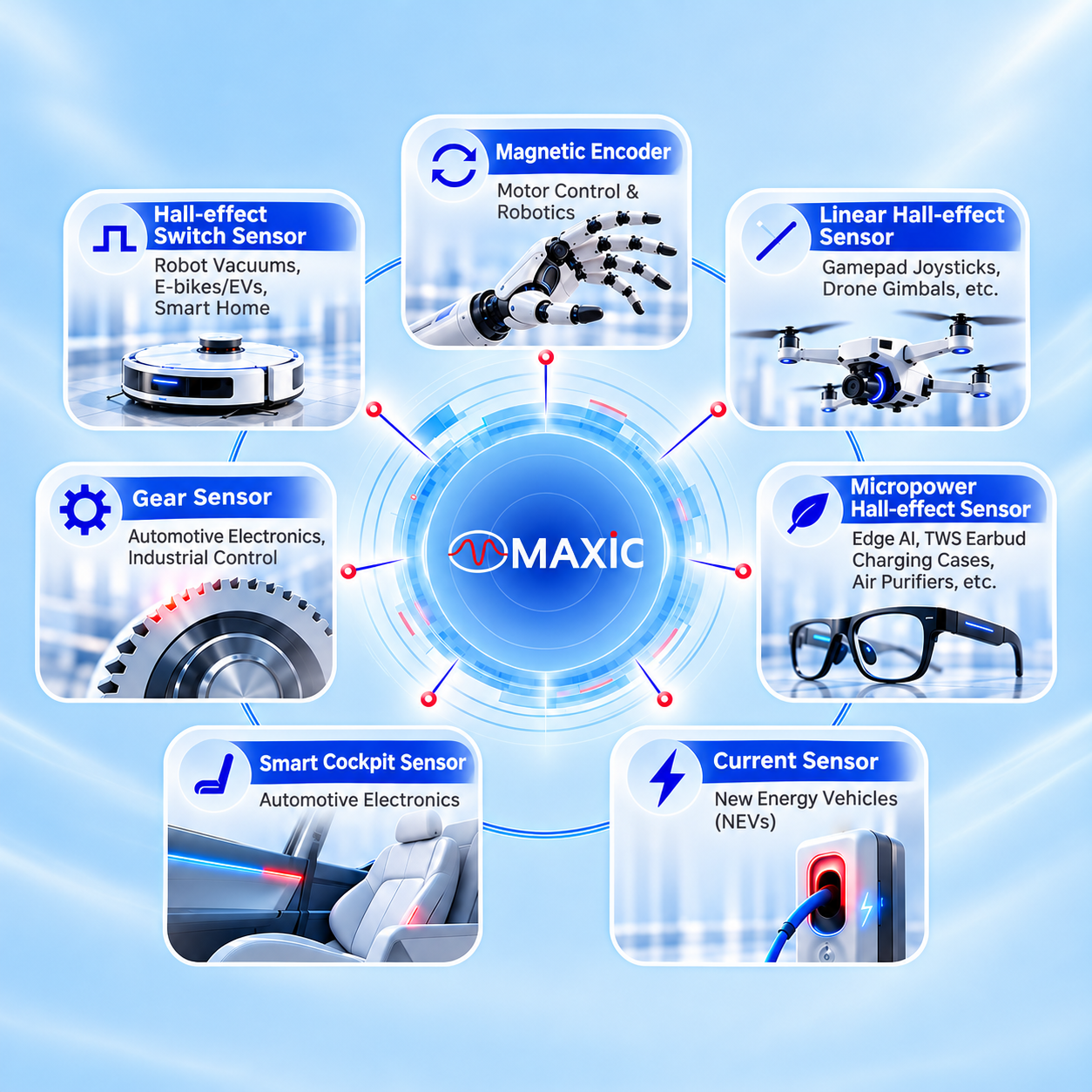
To capitalize on this momentum, Maxic has developed a comprehensive magnetic sensor portfolio, covering Hall-effect switch sensors, linear Hall-effect sensors, micropower Hall-effect sensors, gear sensors, smart cockpit sensors, magnetic encoders, and current sensors. These products are widely used in four major application areas: automotive electronics, robotics, industrial control, and edge AI and smart home.
01
Automotive and Electric Mobility
Automotive-Grade Position and Speed Sensing for Cockpit, Powertrain/Chassis
The automotive sector is one of the largest and most reliability-critical application markets for magnetic sensors. From powertrain and body control to chassis safety and smart cockpits, magnetic sensors provide real-time sensing of position, speed, angle, and current. A qualified automotive-grade magnetic sensor must maintain stable performance across a wide temperature range and operate reliably over the long term in challenging environments involving vibration and EMI.
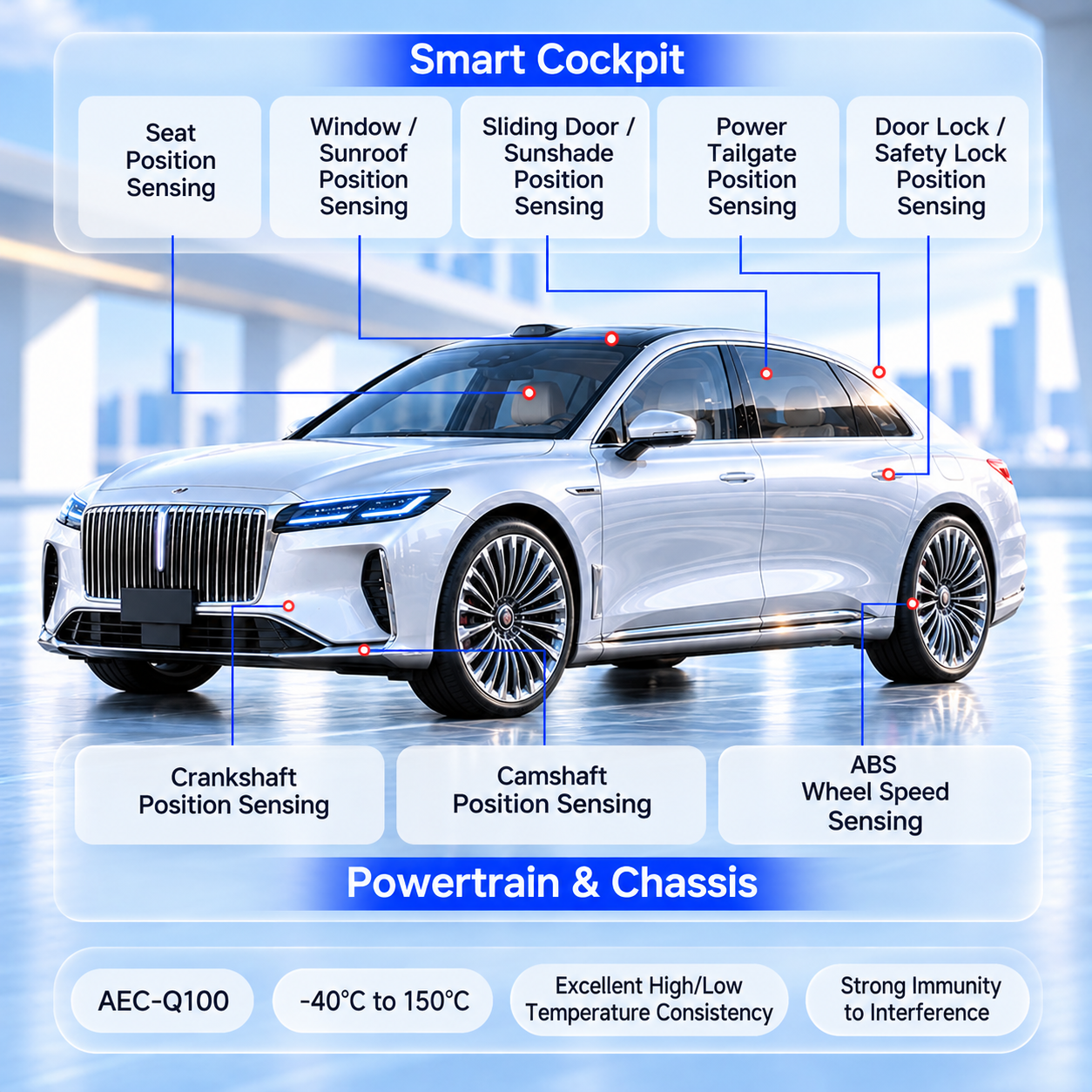
Maxic's automotive-grade magnetic sensor portfolio covers two key sectors: powertrain and chassis systems, and smart cockpit. The smart cockpit sensor series (GH21xx/GH22xx) is designed for position sensing of seats, windows/sunroofs, sliding doors/sunshades, power tailgates, and door locks/safety locks. AEC-Q100 qualified, these sensors feature excellent switching-point stability and consistency across a wide temperature range.
The gear sensor series (GH1922/GH1817/GH5901) is designed for key powertrain and chassis applications, including crankshaft and camshaft position sensing and ABS wheel speed sensing. Based on a differential Hall architecture, the sensors offer strong immunity to interference. GH1922U features China's first ultra-thin package of its kind, offering compact size for soldering. The series is also suitable for motorcycles, including both gasoline-powered and electric models. They meet powertrain and wheel speed sensing requirements, and can also be used for speed sensing in instrument clusters.
In motor sensing applications, Maxic's Hall-effect switch sensors can be used for position sensing in low-speed electric vehicles. GH31xx/GH34xx Hall-effect sensor series are widely used in two- and three-wheel electric vehicles and electric motorcycles from major brands such as Yadea, AIMA, and Ninebot for motor commutation, torque, and position sensing in hub and mid-drive motors.
For current sensing, Maxic's current sensors can be used in applications such as seat heating in NEVs, providing accurate current monitoring and protection.
02
Robotics
Adapting to Multiple Joints and Power Structures, Enriching Embodied AI Sensing Solutions
Under the wave of physical AI, embodied AI and robotics have become the first major domains to reach real-world deployment. To free robot movements from the limitations of "open-loop control" (which lacks feedback and is susceptible to interference) and move toward "precise closed-loop control," real-time, high-precision feedback data is essential, and magnetic sensors are among the core components that provide the required critical data.

To meet the precision sensing requirements of embodied AI, Maxic is expanding its magnetic encoder portfolio building on its existing Hall-effect sensors to deliver high-precision, multi-dimensional sensing.
For medium-to-large robotic joints, such as hips, knees, and elbows, Maxic is developing Hall-array-based, high-precision magnetic encoder chip for combined force and position sensing. It offers arcsecond-level angular resolution, to address the challenges of low jitter and highly accurate absolute position feedback during joint movement.
Maxic also plans a dual-track off-axis encoder chip as a cost-effective complement, targeting applications that require off-axis mounting and higher EMI immunity.
To meet the stringent miniaturization and compactness requirements of finger joints in dexterous hands, Maxic is planning to develop an on-axis magnetic encoder chip designed to deliver highly linear position feedback in extremely space-constrained environments, while providing an interface for future integration of force and tactile sensing.
In powertrain and chassis systems, Maxic's linear Hall-effect sensors (GH39F/GH3562 series) can be used for torque sensing; the Hall-effect switch sensors (GH11xx/GH12xx series) are used for motor commutation and position sensing. These products are already used in applications such as humanoid robots, robot vacuums, and drones.
03
Industrial Control
Providing High-Reliability Sensing for Intelligent Industrial Control and Motor Systems
Industrial environments are complex and place high demands on sensor durability and immunity to interference. With their non-contact operating mode, magnetic sensors feature significant advantages in environments with oil contamination, dust, and wide temperature variations.

For motor and drive systems, Maxic's gear sensors (GH1820/GH1835/GH1836) are widely used in AC induction motors for intelligent industrial control, engineering vehicles (such as forklifts and special-purpose vehicles), and medical equipment. They provide accurate speed and direction sensing. GH1836 features a differential Hall architecture and dual-channel quadrature outputs, ensuring stable operation even in industrial environments with strong EMI. In addition, Hall-effect switch sensors (GH1120 series) can be used for motor commutation and non-contact switch sensing. Micropower Hall-effect sensors (GH1248 series) adopt periodic wake-up mechanism, making them perfect low-power solution for battery-powered industrial devices such as smart meters.
04
Edge AI and Smart Home
Enabling Multi-Dimensional Sensing and Interaction for Edge AI and Smart Home
In edge AI and smart home, the key value of magnetic sensors lies in delivering outsized capability in position or angle sensing within extremely tight space and power budget.

To meet diverse application requirements, Maxic offers comprehensive magnetic sensor portfolio.
Linear Hall-effect sensors (GH39F/GH35xx series) feature high sensitivity and low temperature drift, suitable for position sensing in applications such as game controller joysticks and coffee machine handles.
Hall-effect switch sensors (GH11xx/GH12xx/GH31xx series) offer fast response and strong immunity to interference, applicable to detect the opening and closing of AI glasses temples and the key position sensing on VR controllers.
Micropower Hall-effect sensors (GH12xx series) adopt a periodic wake-up mechanism to reduce power consumption, suitable for low-power position sensing in battery-powered devices such as TWS earbud charging cases and air purifiers.
The rapid adoption of physical AI is reshaping industries across the board. From precise sensing in automotive smart cockpits to arcsecond-level feedback in humanoid robot joints, these applications all rely on accurate, real-time perception of the physical world. Maxic's magnetic sensors are now used in dozens of applications across four major fields. Looking ahead, Maxic will continue to advance its magnetic sensing technology to provide customers with highly reliable, high-performance, and low-power sensing solutions to empower the intelligent transformation of more industries.
Recommended News
-
2022-09-14
Grand launch | MT5785: 100W ultra-fast wireless charging and 18W reverse transmission
-
2022-08-05
Core leads new era | Maxic participated the Guangzhou International Lighting Exhibition 2022
-
2022-07-04
Maxic launched a fully integrated ultra-low power optical proximity sensor
-
2022-06-24
Maxic launched a high performance wired fast charging 20W~65W overall solution
