


 Back
Back
Maxic Announces Strategic Investment in KingKong Technology, Accelerating Its Expansion into the Robotics Intelligent Sensing Market
-

Release Date2026-05-29
-

Page View1687 times

This year, the humanoid robotics industry has seen a wave of mass-production milestones. From the deployment of Tesla's Optimus robots at Gigafactories in Shanghai and Berlin, to Unitree's G1 robots taking on roles at Tokyo Haneda Airport and other locations, and Agibot G2 robots operating continuously on 3C manufacturing lines in Nanchang, humanoid robots are accelerating their transition from laboratories to industrial and everyday applications. According to TrendForce, global humanoid robot shipments will surpass 50,000 units in 2026, representing year-on-year growth of more than 700%. As leading domestic and international enterprises advance toward large-scale production and breakthroughs continue across China's supply chain, the humanoid robotics industry is transitioning from technology validation to large-scale commercialization.
Maxic has made a strategic investment in Beijing KingKong Technology Co., Ltd. and officially entered into a strategic partnership to advance the development of a broad portfolio of sensors for humanoid robots. Through this collaboration, the two companies will focus on intelligent sensing technologies for embodied AI systems to empower the multi-dimensional perception of humanoid robots, capturing a core position in the next-generation AI hardware ecosystem, and accelerate the evolution of robotics toward higher levels of intelligence.
With nearly a decade of expertise in core robotic components, KingKong Technology has grown into a global benchmark company in its field. The company holds more than 80% of the domestic market share for humanoid robot encoders and provides comprehensive solutions for major joints such as the hip, knee, and ankle, as well as precision joints including robotic arms, wrists, and dexterous hands. It serves as a key supplier to leading robot and joint manufacturers in both domestic and international markets.
Furthermore, KingKong Technology has expanded its portfolio into multidimensional sensing solutions, ultra-compact high-precision actuators, and miniaturized high-performance robots. These products are deployed across humanoid robotics, industrial automation, new energy vehicles, defense, and medical applications, serving key customers throughout Europe, North America, Japan, South Korea, Israel, and other international markets.
KingKong Technology has received multiple industry recognitions, including First Prize at the 2025 National Disruptive Technology Innovation Competition, the LeadeRobot Embodied Intelligence Sensor Fusion Innovation Award, and the Humanoid Robot Outstanding Supplier Award, underscoring its technological leadership and innovation capabilities in the robotics industry.
Technology Foundation:
Intelligent Sensing Drives the Future of Embodied AI
Continuous breakthroughs in embodied AI technologies are accelerating the transition of humanoid robots from research laboratories to large-scale mass production. If large AI models provide humanoid robots with the ability to understand tasks, intelligent sensing systems determine whether they can truly perceive, interact with, and operate in the physical world.
Unlike traditional industrial robots that operate on fixed production lines, at fixed workstations, and through predefined motions, humanoid robots are designed to function in unstructured environments characterized by dynamic surroundings, unpredictable objects, and shared human-machine spaces. They must utilize various sensors to identify objects, understand their own posture and motion, and assess force and torque conditions. This information is then transmitted to the robot’s “brain” for decision-making and task planning. Meanwhile, high-precision perception and motion control systems function as the robot’s “cerebellum,” working in tandem to execute the next motion.
Currently, humanoid robots typically integrate a wide range of sensors, including vision, tactile, auditory, and force sensors, as well as encoders. A single humanoid robot generally incorporates 30 to 50 joints, each of which relies on high-precision sensors to enable accurate motion and posture feedback as well as closed-loop control. Magnetic encoders have emerged as a mainstream solution for humanoid robots due to their non-contact sensing, which converts mechanical motion into highly accurate electrical signals. By providing critical functions such as angle measurement, position feedback, and motion control, magnetic encoders are widely deployed in the limbs, torso, and dexterous hand joints of humanoid robots, representing one of the most extensively used sensors in humanoid robotic systems.
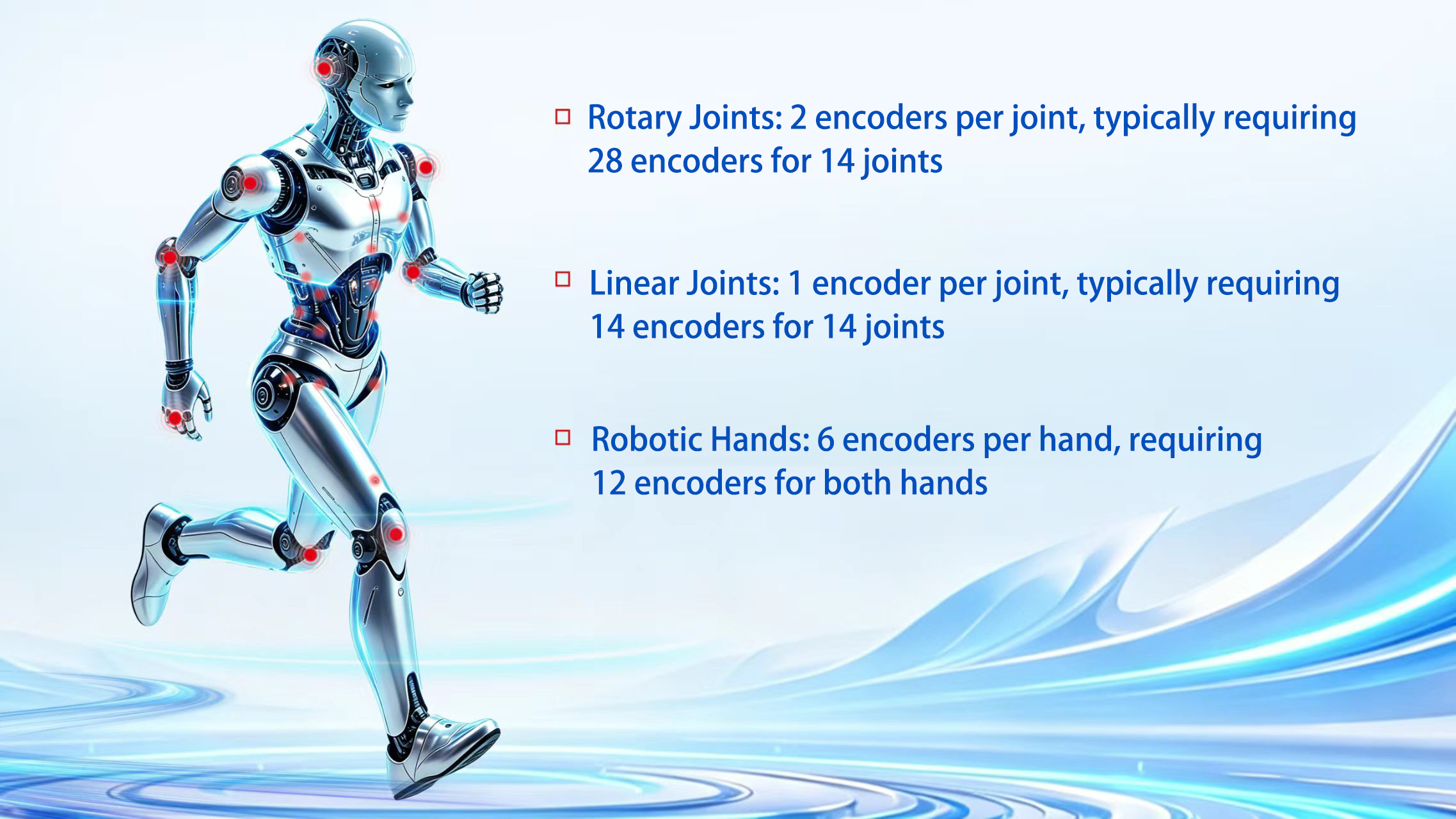
Embodied AI emphasizes a real-time closed-loop interaction between robots and the physical world. Serving as the critical interface between perception and action, robotic sensing system is increasingly defining the performance limits, cost structure, and supply chain resilience of humanoid robots. It stands as a core component in the industry's transition from laboratory to large-scale mass production.
Ecosystem Synergy:
Building a Robotics Sensing Portfolio with Multi-Sensor Technologies
For robotics applications, Maxic has established a technology ecosystem spanning environmental sensing, multimodal perception, and motion sensing and control, creating a comprehensive sensing portfolio that covers vision, tactile, ambient light, spatial awareness, and motion control.
Ambient light sensors (ALS) continuously monitor changes in surrounding lighting conditions, enabling vision systems to maintain clarity and stability even in challenging environments such as backlit or low-light scenarios. This significantly enhances the environmental adaptability and visual reliability of intelligent devices in real-world applications.
Time-of-Flight (ToF) sensors provide intelligent devices with precise spatial awareness capabilities. Through high-precision laser ranging and real-time 3D mapping, they enable devices to better understand their surroundings, interact more intelligently, and navigate autonomously.
Multimodal vision sensors integrate highly sensitive dynamic vision functionalities, allowing precise recognition of object shapes, textures, and motion, while also monitoring contact-induced deformation in real time. These technologies are particularly well suited for applications such as eye tracking and dexterous robotic hands.
Magnetic sensors provide real-time position and angular data feedback, serving as a critical foundation for motion stability, precision control, and operational reliability in intelligent robotic systems
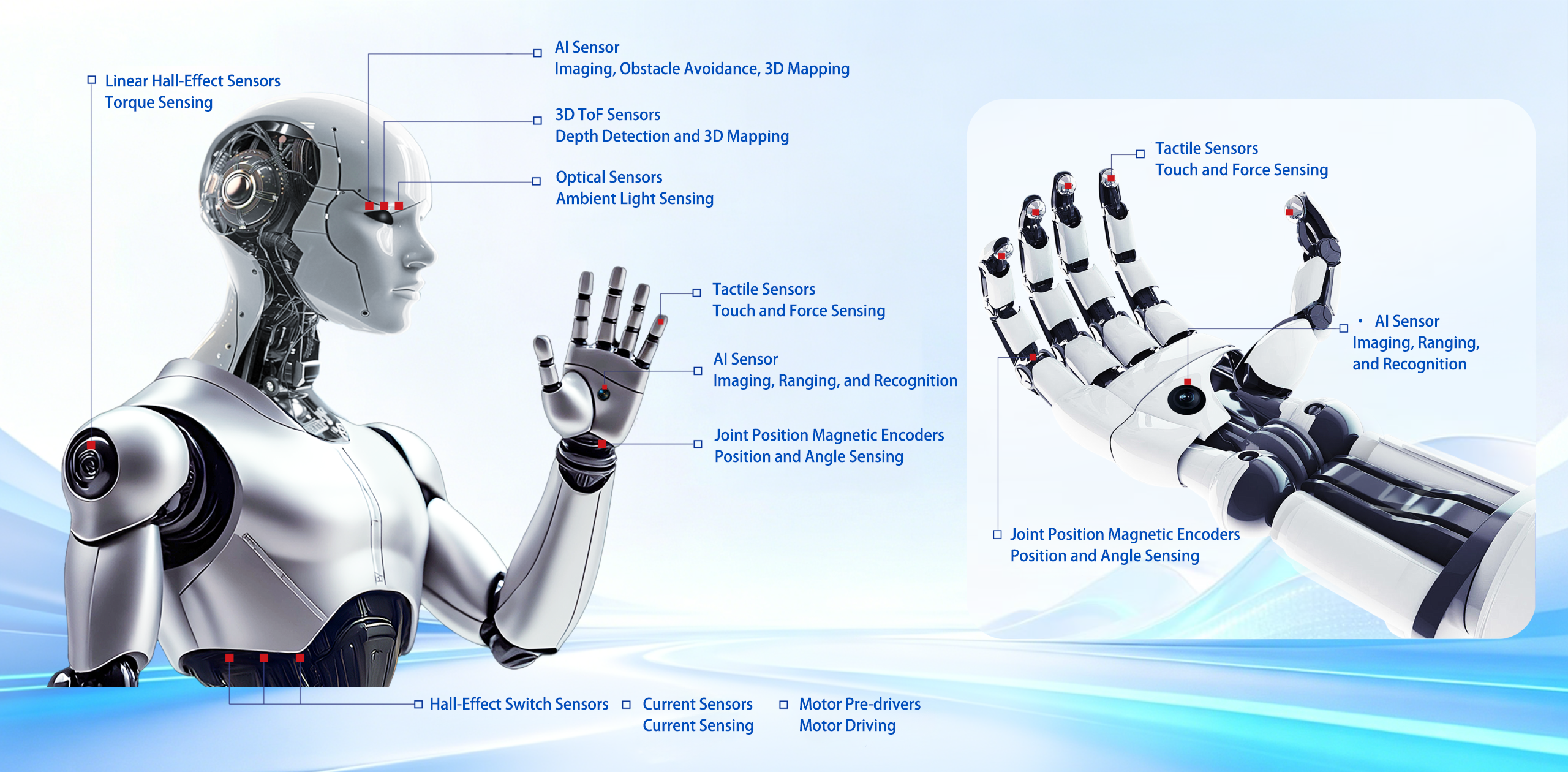
As a highly interdisciplinary field encompassing physics, electronics, and materials science, sensor technology presents substantial technical challenges and barriers to entry. By deeply integrating high-precision sensing technologies into robotic systems, Maxic enables robot manufacturers to lower development barriers, accelerate system integration, and enhances system stability, thereby driving the rapid industrialization of intelligent sensing technologies.
Strategic Value:
Advancing from Humanoid Robotics to Broader AI Equipment
Through its strategic investment in Beijing KingKong Technology Co., Ltd., Maxic has established a strategic partnership with one of China's leading providers of core components for humanoid robots, comprehensively driving the R&D and sales of various sensors required for humanoid robotics. Leveraging its expertise in high-precision, miniaturized, and highly reliable sensor technologies, Maxic is further optimizing its solutions through deep chip-level customization to precisely address the intelligent sensing requirements of humanoid robots, helping them overcome performance bottlenecks and accelerate mass-production deployment.
This strategic partnership carries profound significance for Maxic to strengthen its robotics ecosystem and deepen supply chain synergy. It not only enables the company to rapidly expand into the humanoid robotics supply chain and accelerate the adoption of its technologies in key applications such as robotic joints and dexterous hands, but also reinforces the R&D and deployment of advanced human-like perception capabilities.
More importantly, humanoid robotics serves as a strategic entry point for Maxic to bridge the final gap between intelligent sensing, interaction, and real-world deployment across a broad range of AI-powered devices. This further strengthens the company's "Smartphone + Automotive + Robotics" ecosystem strategy.
Maxic is deeply committed to the high-performance analog and mixed-signal ICs, with a product portfolio spanning intelligent sensors, power management ICs, analog power ICs, and automotive electronics. These solutions empower a wide range of applications across communication terminals, smart homes, and automotive electronics, while the company continues to expand into emerging sectors such as robotics, new energy, and artificial intelligence.
Leveraging its technological expertise in optical sensing, 1D/3D ToF laser ranging, magnetic sensing, and multimodal perception, Maxic is further strengthening scenario-driven innovation in intelligent sensing technologies. By expanding its capabilities in robotic motion perception and collaborative motion control, Maxic continuously broadens its intelligent sensing portfolio and reinforces its technological barriers to entry.
Recommended News
-
2022-09-14
Grand launch | MT5785: 100W ultra-fast wireless charging and 18W reverse transmission
-
2022-08-05
Core leads new era | Maxic participated the Guangzhou International Lighting Exhibition 2022
-
2022-07-04
Maxic launched a fully integrated ultra-low power optical proximity sensor
-
2022-06-24
Maxic launched a high performance wired fast charging 20W~65W overall solution
